
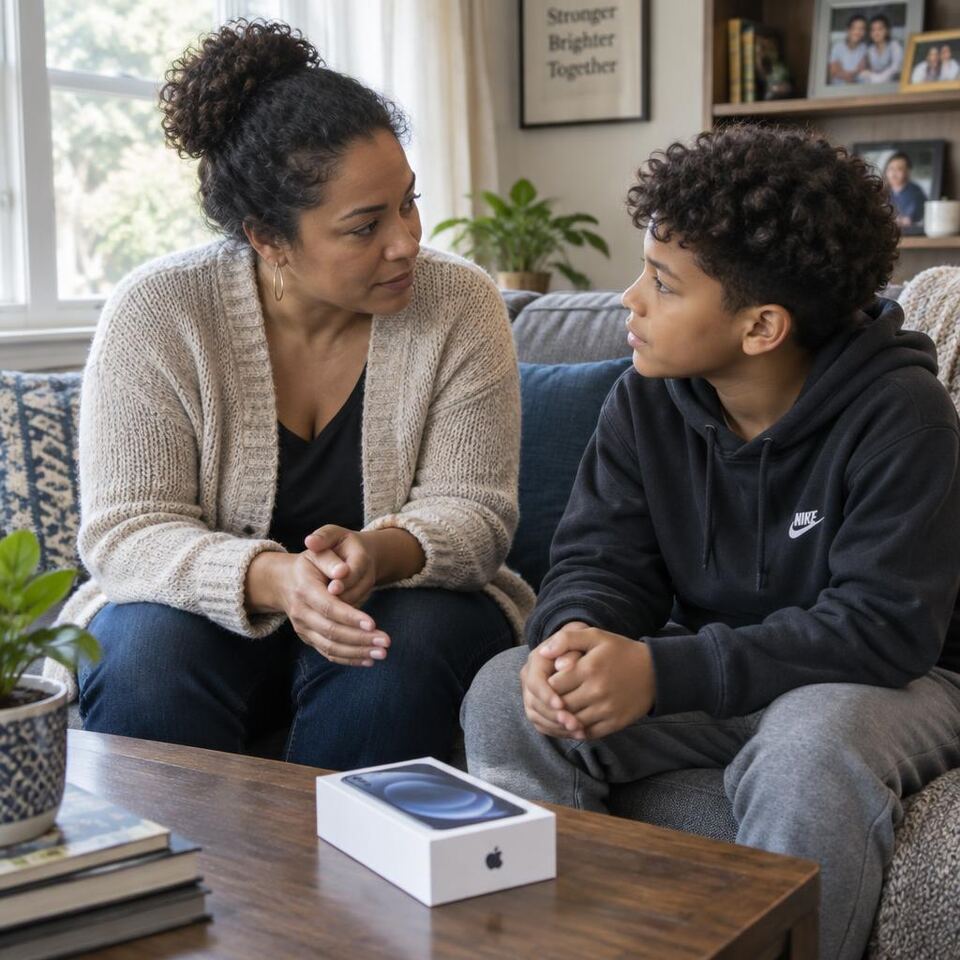
Tech Rules for Our House That Work: 3 Ways to Reduce Screen Time and Distraction
The platforms in our pockets are among the most brilliantly engineered tools in human history, designed by world-class minds to capture and hold our attention. That is why relying on sheer willpower to turn off screens so often fails.
If we want to protect our family's time and focus, we need intentional strategies, not just good intentions.
Here are a few research-backed practices to remove distractions and find margin at home, plus a foundational rule for guiding your kids through the digital world.
1. Eliminate micro-distractions to build deeper connection with your family
Small boundaries around technology can create profound shifts in your household's emotional climate. Try starting with these three shifts:
Put devices completely out of sight
A study from the University of Texas at Austin found that even when a phone is face-down or turned off, its mere presence on a table drains working memory because the brain is actively working not to check it. To give your brain a real break during family meals or conversations, put your phone in another room entirely.
Protect your interactions from "technoference"
Research from the University of Illinois shows that brief micro-interruptions, like glancing at a watch notification mid-sentence, subtly signal to a child that they are not as important as an alert. Child development experts emphasize that brief, fully present interactions build stronger emotional security in kids than long stretches of semi-distracted time. Try creating 10-to-15-minute zero-interruption windows during certain times of day, like right before school or right before bed.
Swap scrolling for a proven recovery method
Social science on leisure quality reveals that passive screen consumption maintains high sensory arousal rather than resetting your nervous system. When you get a free 30-minute block, swap doomscrolling for an off-screen activity, like a short walk, reading, or working with your hands, to genuinely gain energy.
2. Be the "next to last" to let your child adopt new technology
When it comes to introducing devices to children, child therapist Sissy Goff offers a liberating framework: aim to be second-to-last or next-to-last in their peer group to adopt new technology.
As Sissy explains:
"You really want to be aware of where kids are in their class. With kids and letting them get their first email address, definitely phone, definitely social media, you don't want to be the first in their whole grade. But I think you also don't want to be the last, because I think our job as grownups who love kids is to teach them to be responsible with technology use while they live under our roofs."
Why "next to last" works
- It protects them socially: Being the last child to get a technology can unintentionally isolate them from their peer group.
- It preserves your window to mentor them: If we wait until a child is 18 to give them a device, we miss the window to actively coach them, guide them, and process mistakes together while they are still living safely under our roof.
A note of grace: you can always reset the rules
If you've already given your child an iPad or smartphone and are now second-guessing that decision, it's okay.
As the adult in the home, you have full permission to change course. You can sit down with your child and warmly say: "I've been learning more about how these devices affect our minds and our family time. Because I love you and it's my job to protect you, we're going to hit pause and reshape our rules together."
Stepping back is leadership.
Questions parents ask
Continue the conversation
Wisdom is not about rigid perfection; it is about walking thoughtfully, guarding our hearts, and having the courage to adjust our path when we realize a better way forward (Proverbs 4:23, 27).
Go deeper

COMMUNITY
Get Connected
Join a small group of people walking through similar seasons of life.

LEARN
Take the Course
Go deeper with short lessons and simple practices for your family.
Coming soon

Resources from this article
- Ward, A. F., Duke, K., Gneezy, A., & Bos, M. W. (2017). Brain drain: The mere presence of one's own smartphone reduces available cognitive capacity. Journal of the Association for Consumer Research, 2(2), 140–154.
- McDaniel, B. T., & Radesky, J. S. (2018). Technoference: Parent distraction with technology and associations with child behavior problems. Child Development, 89(1), 100–109.
- McDaniel, B. T., & Radesky, J. S. (2018). Technoference: Longitudinal associations between parent technology use, parenting stress, and child behavior problems. Pediatric Research, 84(2), 210–218.
- Sissy Goff and David Thomas. Capable: How to Teach Your Kids the Strengths, Skills, and Strategies to Build Resilience. Bethany House Publishers, 2026.
Keep exploring
More for your family
 Article4 min read
How to Raise Capable Kids: 3 Habits to Build Resilience in Stressed-Out Children
The fastest way to lower stress in your home may be to let your kids take on more. Three simple habits from Sissy Goff and David Thomas.
Read article
 Article4 min read
What Do We Mean When We Say We Want Our Kids to Succeed?
Raising high-achieving kids without adding to the pressure, and helping them know their achievements aren't tied to their worth.
Read article
 Article5 min read
What Happens When Your Child Gets It Wrong?
How to help high-achieving kids handle mistakes, and why the way we react matters more than we think.
Read article