
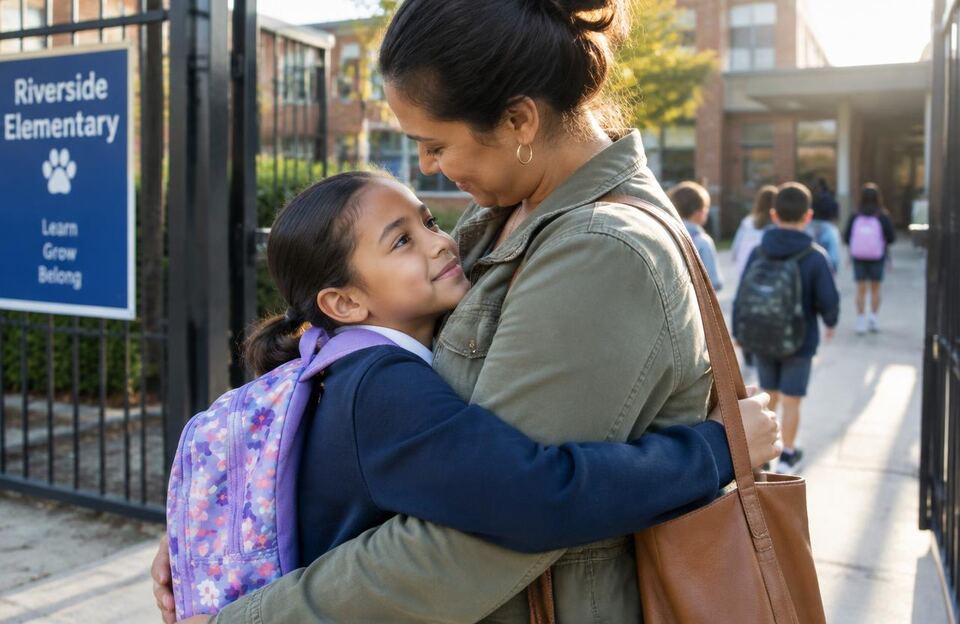
In Silicon Valley and other high-achieving communities, life can easily feel like a continuous, high-stakes scoreboard measured in grades, sports stats, follower counts, and college admissions. Many of us are balancing demanding careers with complex family schedules, doing our absolute best to love, grow, and protect our children.
In this high-pressure, high-tech world, our kids don't need constant rescuing. What they truly need is practice becoming capable, confident human beings.
Why "rescuing" kids increases anxiety and reduces resilience
When our daily bandwidth is already paper-thin, it's often far easier to swoop in and rescue our kids than it is to give them the space to try something hard or even stumble. Many of us were under-parented ourselves, so we work overtime to overcompensate. Or, parenting out of our own subtle anxieties, we shield them from discomfort.
As parents, we intuitively know our children need to take on more responsibility on their own. Yet knowing how to guide them there is hard, especially as more kids navigate anxiety, depression, and a sense that they aren't equipped to handle what life throws at them.
However, developmental research shows that over-supporting a child sends an unintended message: "I don't think you can handle this on your own." Today's social-media-fueled culture of comparison can shrink a child's courage, making them feel ill-equipped for life's challenges.
It can feel like too much. But because you're reading this, we know you want more than anything to get this parenting thing right. You are looking for real answers.
Here is the good news: there are simple, daily ways to build capability in our children. It is never too late, and it is entirely possible.
So how do we equip our kids to navigate setbacks, handle disappointments, and grow stronger through life's natural challenges?
Inspired by child development experts Sissy Goff and David Thomas (authors of Capable), here are two practical ways to start today.
1. Practice competition with compassion
In a culture obsessed with performance, try shifting your everyday conversations away from outcomes, like test scores, wins, or rankings, and toward the things your child can control, such as effort, curiosity, and kindness.
If your child is involved in sports, academics, or group activities, give them a mission: look for a teammate or peer who is having a hard time. Maybe that friend got injured, didn't get much playing time, or repeatedly shanked the ball during practice. Challenge your child not only to notice that person, but to find a way to support them.
This might look like encouraging words ("I saw how hard you worked out there today") or simply choosing to sit next to them at the team dinner.
The goal here is a small but profound shift from performance to compassion.
You can follow up during the drive home with simple questions:
- "Who did you encourage today?"
- "Who did you notice was having a tough time?"
Ancient wisdom reminds us that perfection isn't the standard. Instead, we keep pressing forward, straining toward who we are becoming, while actively choosing to encourage and build up those around us.
2. Allow kids to struggle and practice bouncing back
It takes courage for a kid to try new things. Emailing a teacher, auditioning for a play, or presenting a project to the class can feel overwhelming. And it doesn't always go well. Our natural instinct is to swoop in, smooth the path, or shield them from situations that cause anxiety or carry a risk of failure.
However, as Goff and Thomas note in their book Capable, over-supporting a child can limit their emotional growth and undermine their character development.
Instead of rescuing them, offer empathy plus curiosity. When your child is struggling, use reflective questions to help them cultivate their own resourcefulness.
Real-life scenarios and responses
Scenario A: Your child didn't make the club soccer team.
What to say: "Getting cut is really tough, and I know how badly you wanted to be on that team. Would you want to email the coach together to ask for feedback on what you can work on, or would you like to brainstorm some next steps on your own?"
Scenario B: A friend group didn't make room for them at the lunch table.
What to say: "I completely understand why you felt left out. That hurts. Would you want to practice telling me what you'd like to say to your friend? I'm right here if you want to talk about some ideas."
Empathizing validates their feelings, while open-ended questions reveal what you think about them: I believe you are resourceful, and I believe in you.
Scenario C: They make a choice they regret.
Ask them questions that prompt reflection and not shame:
- "What was happening in that moment that made your choice feel like the right one?"
- "What could you try differently next time?"
We have the profound privilege of helping our kids grow into capable, resilient human beings. And with your steady guidance, they will.
Questions parents ask
Continue the conversation
True growth prioritizes character over perfection. Ancient wisdom reminds us that perfection isn't the standard; rather, we keep pressing forward, straining toward who we are becoming, while actively choosing to encourage and build up those around us (Philippians 3:12–14; 1 Thessalonians 5:11).
Life's natural trials aren't signs that something has gone wrong. They are the very testing ground that produces steadfastness, maturity, and emotional strength (James 1:2–4).
Go deeper

COMMUNITY
Get Connected
Join a small group of people walking through similar seasons of life.

LEARN
Take the Course
Go deeper with short lessons and simple practices for your family.
Coming soon

Resources from this article
- Sissy Goff and David Thomas. Capable: How to Teach Your Kids the Strengths, Skills, and Strategies to Build Resilience. Bethany House Publishers, 2026.
Keep exploring
More for your family
 Article4 min read
How to Raise Capable Kids: 3 Habits to Build Resilience in Stressed-Out Children
The fastest way to lower stress in your home may be to let your kids take on more. Three simple habits from Sissy Goff and David Thomas.
Read article
 Article4 min read
What Do We Mean When We Say We Want Our Kids to Succeed?
Raising high-achieving kids without adding to the pressure, and helping them know their achievements aren't tied to their worth.
Read article
 Article5 min read
What Happens When Your Child Gets It Wrong?
How to help high-achieving kids handle mistakes, and why the way we react matters more than we think.
Read article